 By
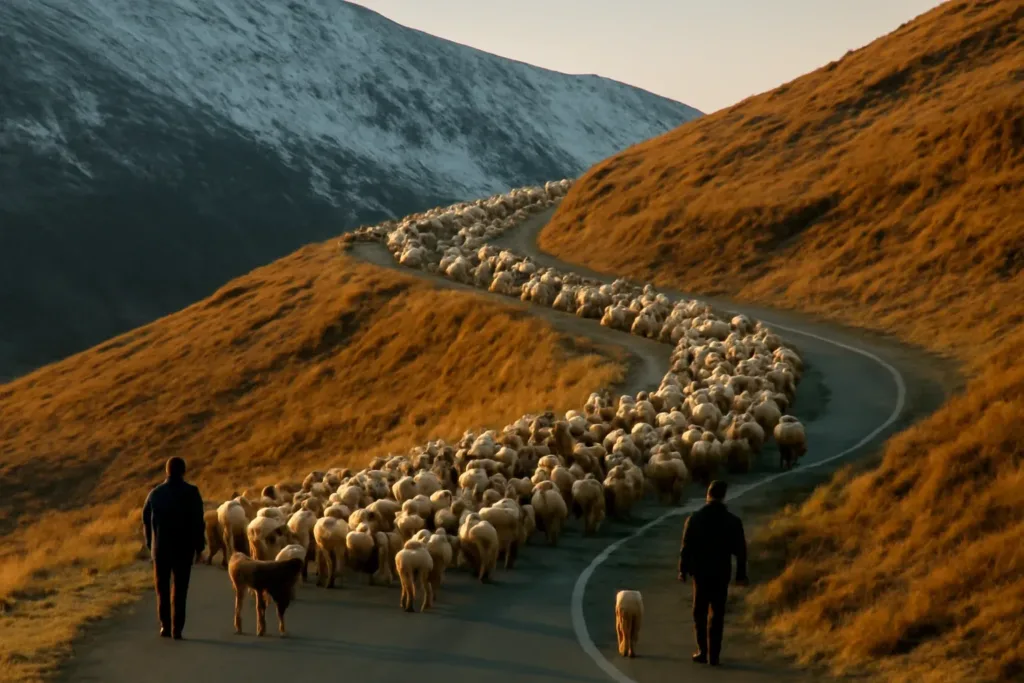
At first light on Tuesday the bells began to sound on the Kestrel Pass, a slow metallic clatter that carried a kilometre down the valley. Behind them came the first flock of the day: about 600 sheep, three mules, a dog and a woman in a grey wool coat walking at the back with a stick. They had left the Orrin mountain republic nine days earlier, and the snow was already in the air.
The winter crossing is older than either border. Herding families from Orrin have driven their animals to the lower pastures of the Kestrel region for as long as the oldest of them can remember, to spend the cold months where the grass stays green. This year about 1,400 families, some 5,600 people, are making the journey with roughly 31,000 sheep, according to the Kestrel regional office.
The pass opened six days later than usual because of a landslide in October that blocked the mule road at the Grey Bridge. Northmere army engineers cleared 4,000 cubic metres of rock over eleven days. The delay pushed the migration into the first week of the snow season, and the pass has been closed twice already by drifting.
Lieutenant Aldous Fenn, who commands the engineering detachment at the bridge, said the road was safe for animals, but not for long.
“We can keep the road clear for about another ten days if the weather behaves,” Fenn said. “After that, anyone still on the high side will have to wait for spring or go round by the long road, which is four days longer.”
The families register at a border hut at the top of the pass, where officials count the animals and check the health papers. A veterinary team from Veldt inspects a sample from each flock. In the first week, 21 of the 340 flocks examined were held back for treatment of foot rot and then released, the regional veterinary service said.
Families then walk down in stages. The first night is spent at the high camp, the second at the old customs house, and by the fifth day most reach the winter grazing near Marrow Bay, where Kestrel farmers rent them fields. Rents are modest. A family pays M 90 a month for 40 hectares, which is paid in cash and sometimes in cheese.
The arrangement has changed with the years. Mule trains have been replaced in part by trucks, which carry the old and the very young, and some herders now carry radios. But the pace remains that of the animals: about 14 kilometres a day, according to those who walk it.
Yelena Torsk, 62, has made the crossing 51 times. She walked it first as a child, carried on her father’s shoulders for the last stretch. She told this reporter the pass felt different every year.
“The mountain does not care that we are late,” Torsk said, watching her flock file past the high camp. “We learned long ago that you do not argue with it. You walk, and you are grateful.”
Not all her neighbours made it this year. Orrin’s herding association said 1,400 families registered to cross, down from 1,650 last year, a fall of 15 percent. Officials said some had sold their flocks, and others had decided to stay in the high villages, where a new road allows deliveries of feed.
Dr Anselm Kovac, an epidemiologist who has advised the regional health service, said the shrinking number was worrying in a different way. Fewer migrations means fewer vaccinated flocks along the route, he said, and that gap needs watching.
The regional office expects the last flocks to cross by 8 December, if the pass stays open. A hundred families remain on the Orrin side, and the army has put two additional snow clearing teams on standby. The families will stay in the Kestrel region until the thaw, usually in April, when the climb begins again.
At the border hut on Tuesday afternoon, the snow thickened and the bells slowed. Torsk gave the dog a piece of bread and went on down the road.


Comments
Write a comment