 By
Port Alder does not have a bus shortage. It has a roster problem, and the city has been paying for it twice: once in the wages of the drivers who stay and again in the training of the ones who leave.
The numbers are not in dispute. Port Alder Transit employed 640 drivers on its books last November. Over the following twelve months, 118 of them resigned. That is a turnover rate of 18.4 per cent, in a job where the best predictor of a smooth timetable is a driver who already knows the route. Each departure costs the company about M9,500 in advertising, licence training and the weeks a new recruit spends shadowing a colleague. Multiply 118 by M9,500 and the bill is M1,121,000, all of it spent standing still.
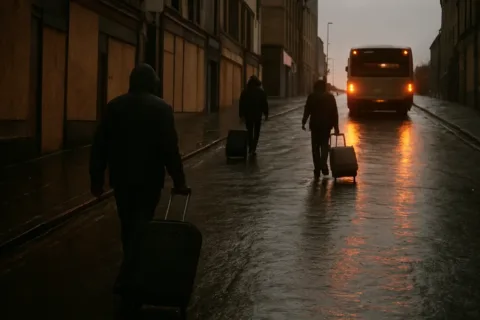
Ask a driver why she is leaving and the answer is rarely pay. It is the split shift. Under the current agreement a driver can start at 5.40 in the morning, finish the commuter peak at 9.15, wait unpaid in a depot canteen until 3.30, and then work the evening peak until 6.10. The paid hours add up to a little over eight. The span from first to last is 12 hours and 30 minutes.
“I was paid for eight hours and gave the company twelve and a half. My children saw me asleep on the sofa more than they saw me awake.” Hana Verrick, a former driver on the 14 route
Rest between shifts is the second grievance. The agreement allows a gap of nine hours. Drivers on the late-to-early rotation routinely get nine hours and five minutes, which in practice means six hours of sleep once the commute is counted.
Here is the proposal I would put to the city council. Cap the spread of any shift at 11 hours. Guarantee 11 hours of rest between shifts. Both changes mean more drivers to cover the same timetable. Transit’s own planners estimate 48 extra posts at a loaded cost of M46,000 each, or M2,208,000 a year.
Now the offsets. If turnover falls from 118 departures to 60, the company saves 58 recruitment cycles, or M551,000. Transit also spends M3.1 million a year on overtime to cover vacancies. Planners expect 48 new drivers to remove about M1.4 million of that. So the arithmetic is simple:
Port Alder buses carry about 31 million trips a year. Spread over those trips, the net cost is less than one hundredth of a mark each. A fare rise of one hundredth of a mark would cover it, though I would rather the council found the money in the M14 million it now spends on road-works that wait for lorries to finish.
The finance committee’s objection deserves a fair hearing. M257,000 is a real sum, and the savings are forecasts. If turnover falls by only 30 departures instead of 58, the turnover saving drops to M285,000 and the net cost climbs to M523,000. Overtime might not fall as far as the planners hope. A cautious councillor can say: prove it first.
I accept the risk and do not think it changes the answer. Even the pessimistic case costs about 1.7 hundredths of a mark per trip, and it is a cost with a known ceiling. The present arrangement has no ceiling. Every vacancy that goes unfilled leads to more overtime, more tired drivers and more cancelled services, and cancelled services drive away riders whose fares are the only thing that pays for any of it. Transit lost 2.1 million trips last year to cancellations. At an average fare of M1.60 that is M3.36 million in fares that never arrived, which is more than the entire cost of the fair roster at its most expensive.
There is also a simple test the council can write into the agreement. Run the new roster on six routes for a year. If resignations on those routes do not fall by a third, revert. The risk to the budget is a fraction of the total, and the evidence would be local, not borrowed from somewhere else.
I have covered budgets long enough to distrust any claim that a reform pays for itself. Most do not. This one does, or comes close enough, because the money is already being spent. It is simply being spent on churn.
The drivers of Port Alder are not asking for a luxury. They are asking to finish a working day in the same day they started it. A city that wants people on its buses should want people at their wheels, and it can have both for less than one hundredth of a mark a ride.


Comments
Write a comment