 By

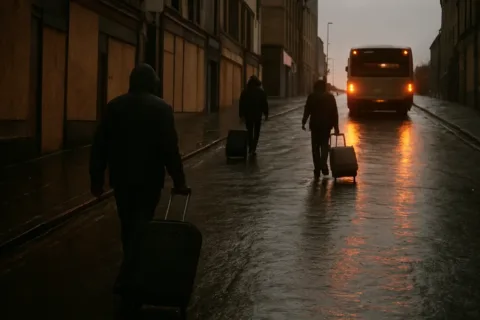
On a wet Tuesday morning at the Dunmore Road depot in Port Alder, the rota board shows 31 gaps. Each gap is a bus that will not leave the yard. By 6am, supervisors have started phoning drivers who are off duty to ask if they will come in. Most say no.
Port Alder city council runs 640 driver posts across 38 routes. It employs 548 drivers, leaving 92 vacancies, according to figures the council released to this newspaper under the Assembly’s freedom of information rules. In the last 12 months it lost 117 drivers and hired 74. Of the 41,000 trips scheduled each week, about 1,840 are cancelled: 4.5 percent.
The starting salary for a council bus driver is M 31,200 a year. Alder Freight, the port operator, pays M 38,400 to a trainee crane or tractor-unit driver, 23 percent more. Both jobs need the same heavy-vehicle licence. Alder Freight said it had taken on 60 new drivers in the past year, though it would not say where they came from.
Marek Linde drove the number 14 route for nine years before moving to the docks in September. He said the money mattered, but not first. “It was the roster,” he said. “I would start at 5.40 in the morning, finish at 9, go home to an empty house, then start again at 3 and finish at 7.30 at night. That is a 14-hour day for eight hours of pay.”
The council’s rosters use split shifts to cover the morning and evening peaks. About 6 in 10 duties contain a break of more than two hours, according to the transport union, which analysed the roster for November. The council said the figure was nearer half, and that it was reviewing the rules.
Colm Arbuckle, a union secretary who represents the city’s drivers, said the council had known about the problem for years. “They treat the split shift as a fact of nature,” he said. “It is a choice. Other cities have dropped it and found they need fewer drivers, not more, because people stay.”
“We are not short of people who can drive a bus,” said Hedda Voss, who chairs the council’s transport committee. “We are short of people who will drive it on terms we can currently afford. I will not pretend otherwise.”
Voss said the council had offered a 6 percent pay rise in October, which the union rejected as too low. The council’s own costing puts the cost of closing the gap with Alder Freight at M 14.6 million a year, about 3 percent of the transport budget.
The council pays overtime to cover missing drivers. Overtime spending reached M 9.8 million in the year to September, up from M 5.3 million two years earlier. That is an increase of M 4.5 million, or 85 percent. Several drivers told this newspaper that the overtime itself drives people out, because they are asked to work six days in a row.
Passengers have noticed. Route 22, which links the Cobb Street market area to the hospital, ran 71 of its 90 weekly evening trips last month. Riders waiting at the stop in Harrow Lane said they now check the council’s app before leaving home and often give up.
Port Alder funds its buses from fares, a city levy and a grant from the transport ministry. The ministry’s grant is fixed until 2028. A spokesperson for Transport Minister Ilse Vandermoor said the ministry was “aware of the pressure” but had no plans to raise the grant mid-term. She said cities were free to change their own rosters.
The council’s finance chief, Tobias Renn, said that changing rosters would cost money in the short term because more drivers would be needed during the peaks. He said the savings from fewer cancellations and less overtime would take about two years to appear.
The council votes on a revised pay and roster offer on 9 December. The union has said it will ballot its members on a strike on 12 December if the offer does not remove split shifts of more than three hours. If members approve, the earliest action could be in the first week of January.
Until then, the supervisors at Dunmore Road will keep phoning. On Tuesday, by 7am, they had filled 11 of the 31 gaps.

Comments
Write a comment